History of the Building
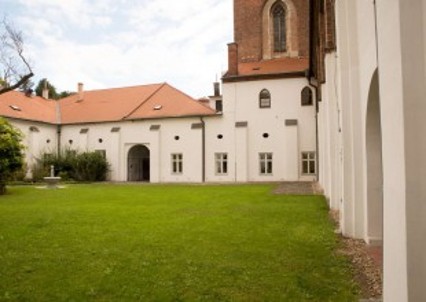
The Refectory of the Augustinian Abbey in Old Brno is located in a wing that was built after the Augustinians moved to Old Brno in 1783. The principal reason for its construction was the need to accommodate the extensive library that the monks had brought with them from their original monastery at what is now Moravian Square. The library had been custom-made for the previous premises, and no suitable space existed for it in the Old Brno monastery. To make way for the new wing containing the library and refectory, the original Cistercian hospital and the Church of St. Anne had to be demolished.
Architecture and Artistic Details
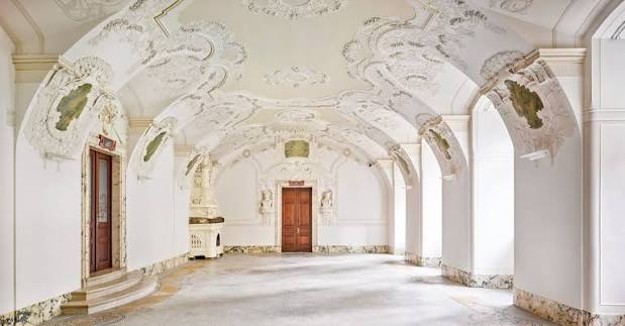
The refectory itself is a Baroque hall completed in 1796. Its present appearance, however, is strongly influenced by the Art Nouveau decorations added in 1910 by J. V. Procházka and K. Novák. The interior was designed in the spirit of the Vienna Secession movement. In 2000, the hall underwent extensive renovation and today serves primarily as a venue for lectures, conferences, and cultural events, including the Mendel Lectures series and chamber concerts.
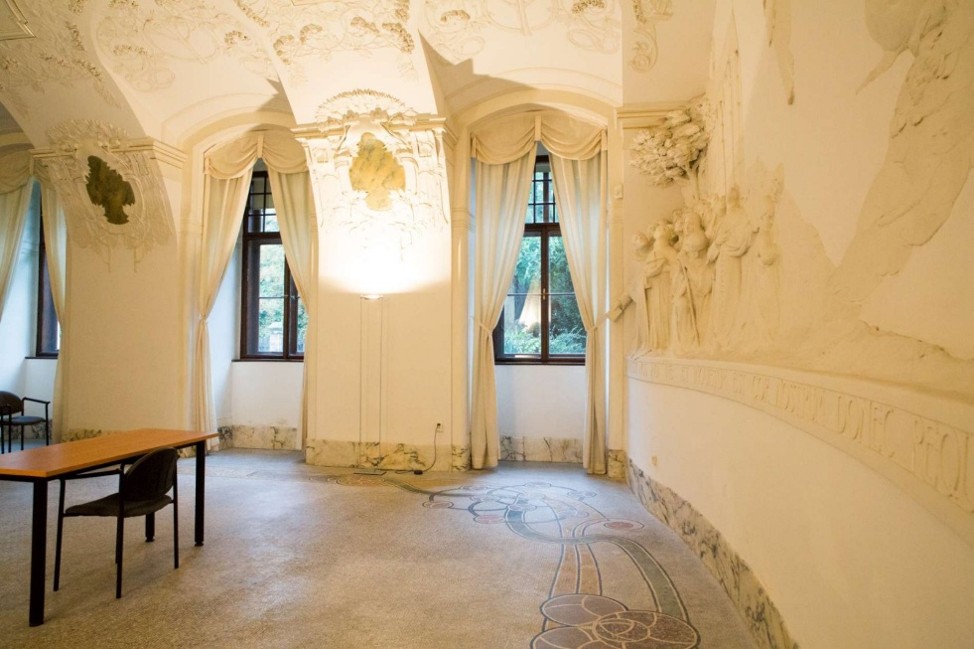
Looking up toward the ceiling, visitors can discover delicate hydrangea motifs. These flowers are known for changing the colour of their blossoms according to soil acidity. The Augustinians compare this transformation to the development of a person's relationship with faith, which is why the hydrangea is one of their favourite flowers. Equally noteworthy is the floor, composed of a stone mosaic with plant ornaments and considered the largest mosaic floor in Brno.
Mendel and the History of Genetics
In 1965, an exhibition dedicated to Gregor Johann Mendel was opened in the refectory. The exhibition panels were unfortunately fixed into the floor using concrete, causing damage that remains visible today in the form of repaired sections.
The exhibition coincided with a genetics symposium held at the Janáček Theatre. Its opening was made possible largely through the strong interest and pressure of international scientists, making it increasingly difficult to ignore Mendel's scientific legacy. At that time, however, it was permissible to speak of Mendel only as a scientist, not as an Augustinian priest. For this reason, the relief on the front wall of the hall was covered.
The Sculptural Relief
The dominant feature of the front wall is a sculptural relief depicting, on the left, a group of pilgrims and Augustinians with the Basilica of the Assumption of the Virgin Mary in the background. On the right are Saint Augustine, holding a cross and bishop's mitre, and his mother, Saint Monica.
The decoration also includes the Latin inscription “Fecisti nos ad te et inquietum est cor nostrum donec requiescat in te”, taken from Augustine's Confessions, which may be translated as:
“You have made us for Yourself, and our hearts are restless until they rest in You.”